Trading
Order Book Manipulation: How to Spot Spoofing, Layering, and Iceberg Orders
May 26, 2026
written by:

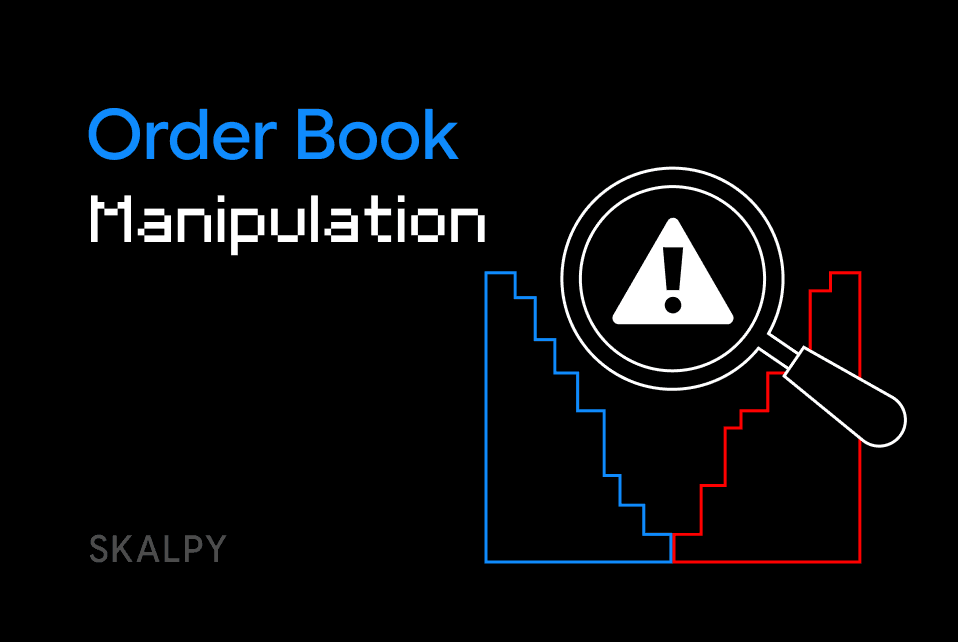
You are watching the order book, and suddenly, a massive wall of buy orders appears just below the current price. Convinced that strong support has stepped in, you enter a long position. But right as the price ticks down to touch those orders, the entire wall vanishes. Seconds later, the price plummets, hitting your stop loss.
This isn't bad luck. You just fell victim to order book manipulation. Understanding how large players manipulate the Depth of Market (DOM) is essential for any scalper. Learning to identify these traps early will help you stop reacting to fake liquidity and start trading the true order flow.
What Is Order Book Manipulation?
The order book displays the resting limit orders (bids and asks) for an asset at various price levels. In theory, it shows the supply and demand. In reality, large players, market makers, and trading bots actively manipulate these visible orders to trick retail traders into buying or selling at unfavorable prices.
Large entities cannot simply execute massive market orders without suffering severe slippage. To get their true orders filled, they use psychological warfare in the DOM to push the price toward their actual targets.
Spoofing: The Fake Wall
Spoofing is the most common form of order book manipulation. It involves a trader placing a massive limit order with absolutely no intention of ever letting it execute.
How it works: A large player wants to sell a significant amount of Bitcoin at $60,000, but the price is currently stalling at $59,800. To push the price up, they place a massive "spoof" buy order at $59,750. Retail traders see this huge buy wall, assume the downside is heavily protected, and start market-buying. As retail buying pushes the price up to $60,000, the large player's real sell orders are filled. The moment their sells are executed, they cancel the massive buy wall at $59,750.
How to spot it:
The Vanishing Act: If a massive order constantly disappears right as the price approaches within a few ticks, it's a spoof. Real buyers want to be filled; spoofers pull their orders to avoid execution.
Out-of-Proportion Size: If a limit order is 10x or 20x larger than the average liquidity at surrounding price levels, treat it with extreme skepticism.
Layering: Creating Fake Momentum
Layering is a more sophisticated cousin of spoofing. Instead of placing one massive fake order, the manipulator places multiple, tiered orders at different price levels to create the illusion of building momentum.
How it works: If a whale wants to push the price down, they will place a series of large limit sell orders (asks) slightly above the current price, stepping down as the price drops. This makes the order book look incredibly top-heavy. Algorithms and retail traders see this intense selling pressure and rush to short the market or sell their longs. Once the manipulator buys up the cheap coins driven down by panic, they cancel the entire "staircase" of sell orders.
How to spot it:
Moving Clusters: Watch for thick bands of orders that continuously step away from the current price whenever the market tries to push toward them.
Imbalanced DOM: An extreme asymmetry in the order book (e.g., 80% asks, 20% bids) that aggressively shifts without actual trades occurring is a red flag.
Iceberg Orders: The Hidden Threat
Unlike spoofing and layering, iceberg orders aren't fake. They are very real, but they hide their true size. Institutional traders use icebergs to execute massive orders without spooking the market.
How it works: Only the "tip" of the iceberg is visible in the order book. If a whale wants to buy 1,000 BTC, placing a single 1,000 BTC bid would cause the price to instantly skyrocket as sellers pull their asks. Instead, they use an algorithmic iceberg order that only shows 10 BTC in the DOM. Every time someone sells 10 BTC into them, the algorithm instantly reloads another 10 BTC at the exact same price.
How to spot it:
Total Absorption: You will see aggressive market selling hitting a specific price level on the Tape (Time and Sales), but the price refuses to drop.
Flashing Refills: If you watch the DOM closely, you will see a small limit order get completely filled, only to instantly reappear at the exact same size.
How to Trade Around Manipulation
Trust the Tape, Not Just the DOM
The golden rule of scalping order flow is that the DOM shows intent (which can be faked), while the Tape shows execution (which cannot be faked). Never base a trade solely on a large wall in the order book. Wait to see if aggressive market orders are actually interacting with that wall.
Use a Professional Trading Terminal
Spotting micro-changes in liquidity, flashing icebergs, and spoofed walls is nearly impossible on standard crypto exchange web interfaces due to lag and limited data aggregation. For active scalpers, seeing these shifts in milliseconds is critical. This is where trading with a specialized terminal like Skalpy becomes essential. A dedicated DOM allows you to aggregate order book data, filter out small noise, and visually track where the real liquidity is resting versus where it's being pulled.
Fade the Spoof
Advanced scalpers often use spoofing to their advantage. If you identify a massive, obvious spoof wall designed to push the price in a certain direction, you can anticipate the reversal. Once the manipulator gets their true order filled and pulls the spoof wall, the artificial pressure collapses, often resulting in a sharp snap-back in the opposite direction.
The Bottom Line
Order book manipulation is a constant reality in cryptocurrency markets. Large players will always use their capital size to create psychological traps for smaller participants.
Instead of getting frustrated when a support wall vanishes, learn to read the mechanics behind the move. By understanding spoofing, layering, and iceberg orders, you transition from being the liquidity that whales prey on to a trader who can ride their coattails. Mastering this requires screen time, discipline, and the right software. Ready to stop trading blind and start seeing the real order flow? Download Skalpy and equip yourself with the tools professional scalpers use to read the tape.
Scalping
Maker vs Taker Crypto Fees: Optimize Scalping Costs
Learn the difference between maker and taker fees. Discover how crypto scalpers optimize trading costs, use limit orders, and maximize profit margins.
Trading
Tokenized Assets: What They Are and Why Every Trader Should Know
Discover how tokenized assets bring stocks, gold, and oil on-chain. Learn how to trade RWA 24/7 with instant settlement and fractional ownership on Hyperliquid.
Scalping
What Is the DOM in Trading? How to Read Depth of Market Like a Pro
Learn how to read Depth of Market (DOM) in trading. Understand order books, bid-ask walls, and liquidity levels to make smarter trading decisions in stocks, futures, and crypto markets.