
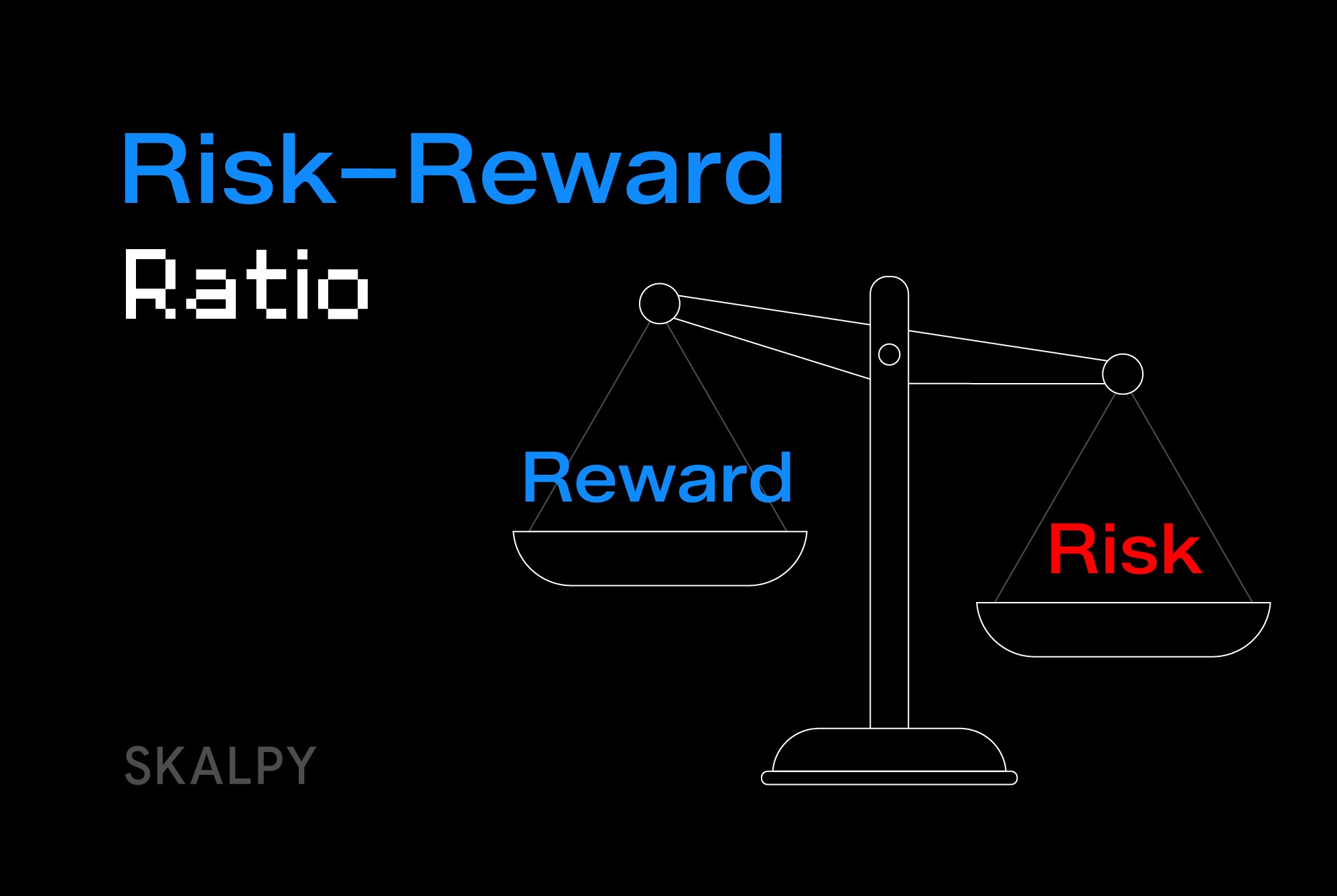
Risk-reward ratio is the single most important mathematical concept in trading. It determines whether you can be profitable long-term even with a modest win rate. Understanding and applying proper risk-reward transforms trading from gambling into a statistical edge that compounds over time.
Most beginners focus obsessively on win rate, trying to be right as often as possible. Professional traders focus on risk-reward, knowing that being right 40% of the time with proper risk-reward generates more profit than being right 60% with poor risk-reward.
What Is Risk-Reward Ratio?
Risk-reward ratio compares how much you're risking on a trade to how much you're targeting as profit. It's expressed as a ratio like 1:2 or 1:3.
A 1:2 risk-reward means you're risking $100 to potentially make $200. A 1:3 risk-reward means risking $100 to target $300. The first number represents your risk (distance from entry to stop loss), the second number represents your reward (distance from entry to profit target).
For example, you buy Bitcoin at $30,000 with a stop loss at $29,500 (risking $500) and a profit target at $31,000 (targeting $1,000 profit). Your risk-reward ratio is 1:2 because your potential reward ($1,000) is twice your risk ($500).
Why Risk-Reward Ratio Matters
The Math of Profitability
Risk-reward ratio determines what win rate you need to be profitable. With 1:1 risk-reward, you need to win over 50% of trades just to break even (accounting for transaction costs). With 1:2 risk-reward, you only need to win 34% to break even, and a 45% win rate generates solid profits.
Consider two traders over 100 trades, each risking $100 per trade:
Trader A: 1:1 risk-reward, 60% win rate
60 wins × $100 = $6,000 profit
40 losses × $100 = $4,000 loss
Net: $2,000 profit
Trader B: 1:3 risk-reward, 40% win rate
40 wins × $300 = $12,000 profit
60 losses × $100 = $6,000 loss
Net: $6,000 profit
Trader B makes three times more profit despite winning 20% less often. This is the power of risk-reward.
Psychological Advantage
Knowing you can be wrong more than right and still profit reduces pressure. You don't need to predict every move perfectly. This psychological freedom improves decision-making since fear of being wrong has less influence.
Compensates for Inevitable Losing Streaks
Every trader experiences losing streaks regardless of skill. With proper risk-reward, a few winners compensate for multiple losers. A three-trade losing streak followed by one winner at 1:3 risk-reward leaves you in profit overall.
Calculating Risk-Reward Before Every Trade
Calculate risk-reward before entering, not after. This ensures you only take trades offering acceptable ratios.
Step 1: Identify Your Entry
Determine your exact entry price based on your strategy. For scalpers using Skaply, this might be a specific price level where your setup confirms.
Step 2: Set Your Stop Loss
Place your stop based on market structure, not arbitrary distances. For long trades, stops go below support or recent swing lows. For shorts, stops go above resistance or recent swing highs.
Your risk is the distance from entry to stop loss. If entering Bitcoin at $30,000 with a stop at $29,700, your risk is $300.
Step 3: Identify Your Target
Set a realistic target based on market structure and conditions. This might be the next resistance level, a measured move projection, or a technical target based on your strategy.
If your target is $30,900, your potential reward is $900.
Step 4: Calculate the Ratio
Divide reward by risk: $900 ÷ $300 = 3. Your risk-reward ratio is 1:3.
If this ratio meets your minimum requirement (typically 1:2), the trade is viable from a risk-reward perspective. If not, skip it regardless of how good the setup looks.
Minimum Risk-Reward Standards
The 1:2 Rule
Professional traders typically require minimum 1:2 risk-reward on every trade. This ensures profitability with modest win rates and provides cushion for transaction costs and inevitable slippage.
Some strategies can work with 1:1.5 in specific market conditions, but going below this makes consistent profitability extremely difficult. You need over 60% win rate to profit with 1:1 risk-reward after costs, which is challenging to maintain.
When to Accept Lower Ratios
In ranging, choppy markets, achieving 1:2 or better may be unrealistic. During these conditions, some traders accept 1:1.5 risk-reward but compensate by being more selective, taking fewer trades, and requiring additional confluence.
High-probability setups in strong trends might warrant accepting slightly lower risk-reward since win rate is likely higher. However, this requires honest assessment of probability, not wishful thinking.
Aiming Higher
In trending markets or during high volatility, targeting 1:3 or even 1:4 risk-reward becomes realistic. These trades allow you to be wrong frequently while still generating excellent returns.
Don't force unrealistic risk-reward in poor conditions, but don't settle for poor risk-reward in conditions that support better ratios.
Risk-Reward in Different Trading Styles
Scalping
Scalpers often work with 1:1.5 to 1:2 risk-reward due to shorter timeframes and smaller moves. The strategy compensates through higher trade frequency and win rate. Transaction costs matter more for scalping, making even 1:1.5 challenging without tight spreads and minimal slippage.
Quality execution platforms matter enormously for scalpers since slippage and spread width directly impact whether your actual risk-reward matches your intended risk-reward.
Day Trading
Day traders typically target 1:2 to 1:3 risk-reward. The longer holding periods and larger timeframes support wider targets while still maintaining realistic expectations.
Swing Trading
Swing traders can target 1:3 to 1:5 or higher since they're capturing multi-day or week-long moves. The longer timeframe allows for wider stops and larger targets while maintaining realistic risk-reward.
Common Risk-Reward Mistakes
Setting Targets Based on Hope
Your target should be based on realistic market structure, not on how much you want to make. If the next resistance is $500 away but you're targeting $1,500 because you "need" that to achieve 1:3 risk-reward, you're setting yourself up for failure.
If market structure doesn't support your minimum risk-reward requirement, skip the trade. Don't force targets that market conditions won't support.
Moving Targets During the Trade
You set a 1:2 risk-reward target before entering, but when price approaches your target, you move it further hoping for more profit. This destroys your statistical edge.
Set your target before entering and honor it. If you want to let partial positions run, that's fine, but take at least partial profits at your original target.
Ignoring Transaction Costs
Calculate risk-reward based on net profit after spreads, commissions, and expected slippage. If your gross risk-reward is 1:2 but costs consume 20% of your gains, your net risk-reward is closer to 1:1.6.
This is particularly important for scalpers where transaction costs represent a larger percentage of profit per trade.
Using the Same Risk-Reward for All Conditions
Market conditions change. Strong trending conditions support wider targets. Choppy, ranging conditions require more modest targets. Adapt your risk-reward expectations to current market behavior rather than rigidly applying the same ratio regardless of conditions.
Scaling Out: Advanced Risk-Reward Management
Rather than all-or-nothing exits, many traders scale out of positions, taking partial profits at multiple targets.
For example, with 1:3 risk-reward:
Exit 50% at 1:2 (secure profit)
Exit 25% at 1:3 (original target)
Let final 25% run with trailing stop (maximize winners)
This approach guarantees profit on the majority of winning trades while allowing a portion to capture extended moves. Your overall risk-reward becomes a weighted average of your exits.
Scaling requires calculating position sizes that allow meaningful scaling (difficult with very small accounts) and adds complexity, but it offers a balanced approach between securing profits and maximizing potential.
Risk-Reward and Win Rate Relationship
Understanding the mathematical relationship between risk-reward and required win rate helps set realistic expectations.
Required Win Rate Formula: Win Rate Needed = Risk ÷ (Risk + Reward)
For 1:2 risk-reward: 1 ÷ (1 + 2) = 0.33 or 33% (need 34% win rate to break even)
For 1:3 risk-reward: 1 ÷ (1 + 3) = 0.25 or 25% (need 26% win rate to break even)
For 1:1 risk-reward: 1 ÷ (1 + 1) = 0.50 or 50% (need 51%+ win rate to break even)
These are break-even rates before costs. Add 5-10% to account for transaction costs and slippage for realistic profitability thresholds.
Tracking Your Actual Risk-Reward
Your intended risk-reward and your actual realized risk-reward often differ. Track both to understand your real performance.
Intended Risk-Reward: What you calculated before entry Realized Risk-Reward: What actually happened
If you consistently plan 1:2 trades but realize 1:1.3 trades, something is wrong. Perhaps you're exiting early, your stops are getting hit too close to target, or slippage is larger than expected.
Monthly review of intended versus realized risk-reward reveals execution problems that need addressing.
Risk-Reward in Crypto Markets
Crypto's high volatility supports better risk-reward ratios than many traditional markets. Bitcoin moving 3-5% intraday is normal, allowing realistic 1:3+ risk-reward on day trades.
However, volatility cuts both ways. The same volatility that creates opportunities for large rewards can hit stops faster. This makes stop placement and position sizing even more critical.
During extreme volatility, consider reducing position size rather than widening stops to maintain your intended dollar risk while adapting to current conditions.
The Bottom Line
Risk-reward ratio is non-negotiable mathematics. It determines whether your trading can be profitable long-term regardless of how good your analysis is. A strategy with poor risk-reward will fail even with good entries. A strategy with excellent risk-reward can succeed with mediocre entries.
Calculate risk-reward before every trade. Require minimum 1:2 for most setups. Skip trades that don't meet your standards regardless of how compelling they seem. Track your realized risk-reward to ensure execution matches planning.
The beauty of risk-reward is that it's completely within your control. You can't control whether a trade wins or loses, but you absolutely control your risk-reward ratio through stop placement and target selection. Master this, and profitability becomes a mathematical certainty over sufficient trades rather than hoping to be right more often than wrong.

Scalping
Choosing the Right Crypto Assets for Scalping Success
Learn how to select the best cryptocurrencies for scalping based on liquidity, volatility, spreads, and volume to maximize your scalping profitability.
Trading
The Essential Pre-Trade Checklist: Never Enter Without These Confirmations
Use this comprehensive trading checklist before every trade to confirm setups, manage risk properly, and avoid impulsive decisions that lead to losses.
Trading
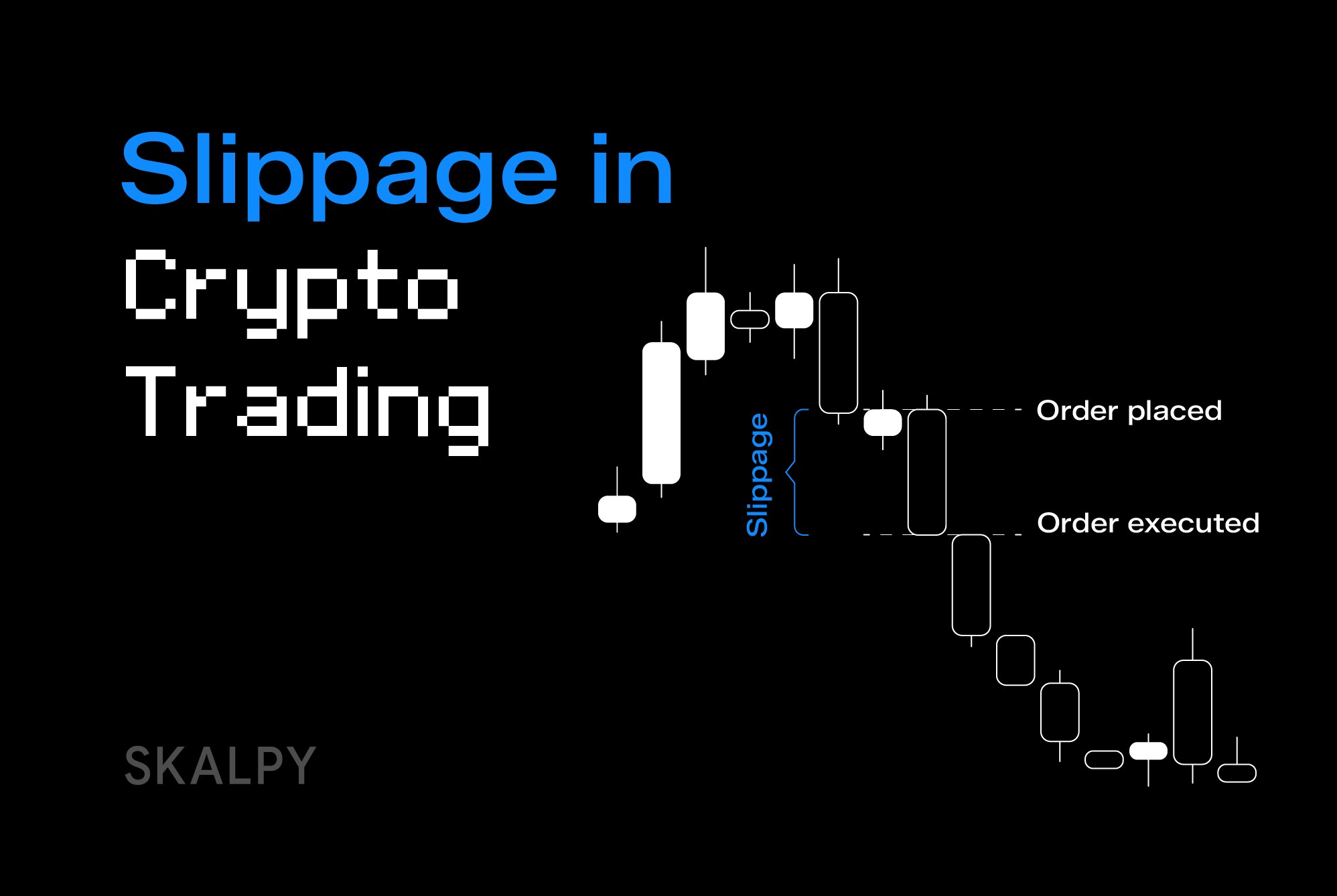
Slippage in Crypto Trading: What It Is and How to Minimize It
Discover what slippage is in crypto trading, why it happens during volatile markets, and learn practical strategies to minimize slippage and protect your profits.